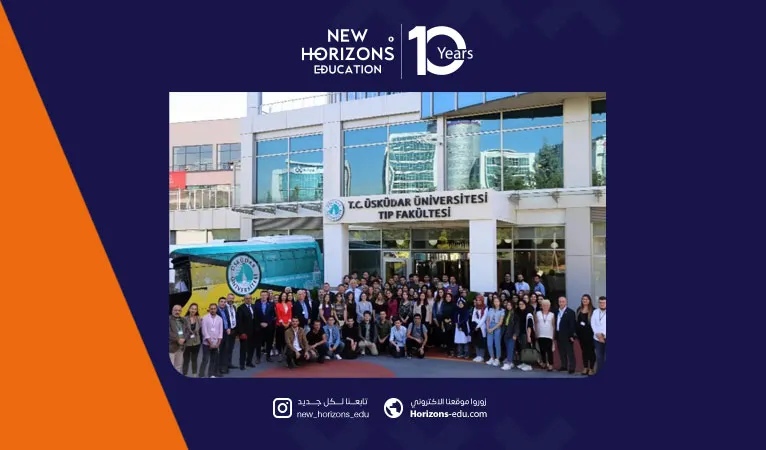
Studying medicine abroad has become an increasingly popular option for students seeking high-quality education at affordable costs, and Turkey stands out as a leading destination.
If you're looking for the best university to study medicine in Turkey, Uskudar University offers a comprehensive learning environment that combines modern academic education, practical medical training, and advanced scientific research.
In this guide to how to study medicine at Uskudar University, you'll discover why hundreds of international students choose it: is it because of the quality of education, the modern infrastructure, the international recognition, or all of the above?
The Faculty of Medicine at Uskudar University was officially established on March 15, 2018, with the aim of preparing contemporary physicians capable of meeting the challenges of modern medicine and innovating in various fields.
Today, Uskudar University is one of Turkey's leading universities in the health sector, having successfully achieved international quality standards in medical education through its state-of-the-art resources, laboratories, and research centers.
To graduate physicians equipped with the scientific and ethical skills necessary to serve society and humanity.
To become a global leader in medical education and research.
The medical education infrastructure at Üsküdar University covers an area of 7,000 square meters and includes classrooms equipped with modern educational technologies, a faculty library, training laboratories covering various disciplines, and advanced research centers.
It also collaborates with leading hospitals in Turkey to provide clinical training by a select group of medical professionals.
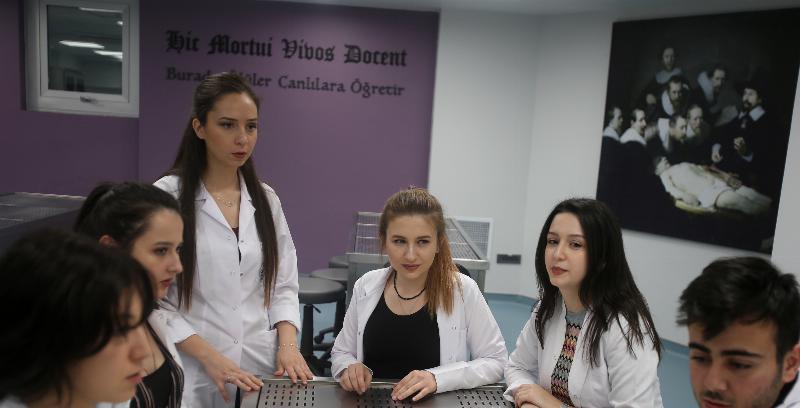
If you're wondering why students choose to study medicine at Uskudar University, here's a list of the most important advantages and reasons that attract them:
Uskudar University is one of the Turkish universities that teaches medicine in English. It also offers courses focused on equipping students with international medical communication and research skills.
In addition, it offers another medical program in Turkish, making it an ideal option for those wishing to study and live in Turkey after graduation.
The medical program at Uskudar University lasts six academic years and includes three essential phases of medical education:
We have explained each stage in detail in the following paragraph.
Medical students at Uskudar University go through a structured educational process that begins with three stages:
Here, students acquire the fundamentals of medicine and biomedical sciences, studying:
Following this, students begin their clinical training period, which includes practical courses in various medical specialties such as:
This is the practical application phase within NP Health Group hospitals, in departments such as emergency medicine, pediatrics, internal medicine, general surgery, public health, obstetrics and gynecology, psychiatry, neurology, and dermatology and venereology, so that the student gains direct experience in dealing with patients and practicing medical procedures under the supervision of experts.
Uskudar University Faculty of Medicine boasts a comprehensive range of modern laboratories designed to provide students with advanced practical experience that simulates a real hospital environment. Below is a detailed overview of the faculty's key laboratories:
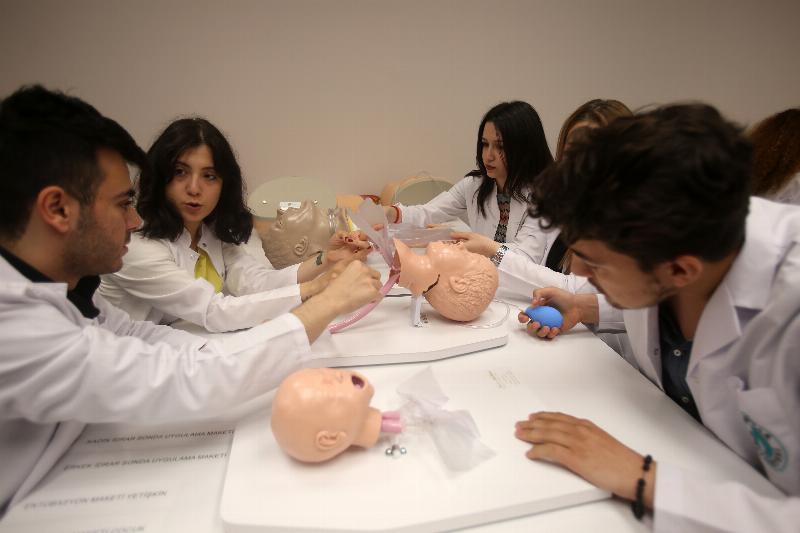
This lab is one of the most important educational facilities in the College of Medicine. Its aim is to train students in basic medical procedures using realistic simulation models before they interact with real patients, based on the principle of "first, do no harm."
The lab contains models of adults, children, and infants to practice skills such as:
The aim of these exercises is to build students' confidence and develop their manual dexterity before actual clinical practice.
This laboratory allows students to apply their theoretical knowledge in basic sciences within a comprehensive practical environment and is used in the fields of:
This laboratory helps students bridge the gap between theory and practice through experiments and practical observations, deepening their scientific understanding.
One of the most advanced laboratories in the Faculty of Medicine, led by Professor Dr. Erkument Özdoğan, this laboratory allows students to interact with trained simulated patients representing various medical conditions, with the aim of training them in:
The lab consists of three realistic simulation rooms for examining and interviewing patients, providing a safe, risk-free environment for applying clinical skills without fear of error. This helps build self-confidence and practical experience before real practice.
Led by Professor Dr. Noureddine Ali Berkoul, this distinguished facility within the Faculty of Medicine houses a wide array of high-quality anatomical models that enable students to visually study the structure of the human body and understand intricate organs and tissues.
These models provide an opportunity to reinforce learning beyond dissection sessions and are used in:
Represents the core of traditional medical education, giving each student the opportunity to dissect a real cadaver in a safe and hygienic environment. State-of-the-art embalmed cadavers are used and renewed annually, allowing students to:
Located on the NP University campus, this laboratory provides a state-of-the-art imaging environment with teaching microscopes connected to screens for real-time display of preparations. It is used for practical applications in the following courses:
This laboratory helps students transition from theoretical knowledge to microscopic observation and practical analysis, enhancing their ability to interpret subtle pathological changes.
Read more: Registration at Uskudar University
Uskudar University attaches great importance to scientific research and development in the field of medicine, and for this reason it has established a group of medical research and application centers that are among the most prominent facilities in Turkey in terms of equipment and scientific diversity.
This center is one of the first specialized centers in Turkey dedicated to the study of chronic and acute pain. It focuses on:
This center focuses on personalized medicine, a modern trend in contemporary medicine, and aims to:
METIFLAM is a leading center in the study of metabolic and chronic inflammatory diseases, conducting advanced research in:
This center is one of the most important centers affiliated with Uskudar University. It is directly linked to NPİSTANBUL Hospital, which specializes in brain and neurological diseases, and focuses on:
This center serves as a bridge between neuroscience and modern medicine, making Üsküdar University the leading university in behavioral and neurological medicine in Turkey.
This center embodies the university's commitment to integrating modern and complementary medicine based on recognized scientific principles. It focuses on:
This center focuses on the study of child and adolescent development, with a particular emphasis on autism spectrum disorders. Its objectives include:
This center serves as an integrated platform for promoting public health and disease prevention through research, education, and practice. Its focus is on:
We conclude that Uskudar University, with its advanced laboratories and research centers, provides students with a comprehensive educational system that combines scientific innovation with practical application, preparing them to be modern physicians possessing skill, knowledge, and compassion.
As a testament to its commitment to medical research, Uskudar University has established a large library dedicated to its Faculty of Medicine, serving as a reliable source of medical information for its students.
The library spans 550 square meters, has a capacity of 122 people, and contains:
The tuition fees for studying Human Medicine in English at Uskudar University are $21,000 USD per year, while the cost for the Turkish-language program is $19,000 USD per year.
To be admitted to the Faculty of Medicine at Uskudar University, you only need to submit your high school diploma with a minimum grade of 85%. There are no specific entrance exams such as the YÖS or SAT.
The good news is that the university does not require language proficiency for admission. Whether you wish to study in English or Turkish, the university assesses the student's level and offers a preparatory year for language learning if needed.
Here are the practical steps to begin preparing, registering, and studying at Uskudar University's Faculty of Medicine:
You can register and apply to the university online by submitting translated and certified electronic copies of the following:
You can fill out the application form on the university's official website, or if you're worried about making a mistake, you can enlist the help of the New Horizons team to complete this step for you free of charge.
After you submit your application to the university, you will receive a conditional acceptance letter. You will be required to pay a portion of the medical school fees to secure your place while you are attending the university.
Uskudar University requires foreign students to attend in person to submit all original documents and pay the remaining tuition fees in order to start studying at the Faculty of Medicine.
Graduates of the Faculty of Human Medicine at Üsküdar University enjoy a promising professional future both locally and internationally, thanks to the university's wide recognition and the commitment of its academic programs to European and international standards.
Uskudar University is a member of the Bologna Process, an agreement that obligates the university to implement the same European standards as other European universities. This means that a medical degree from Üsküdar University is recognized throughout Europe.
Furthermore, the university is recognized in several Arab countries, allowing its graduates to easily work or pursue postgraduate studies in those countries. These countries include:
Having explored the human medicine program at Uskudar University, including its traditional and modern medical curriculum, and the advanced state of its medical school, which boasts laboratories and research centers dedicated to cutting-edge medical sciences, we can confidently conclude that Uskudar University is one of the best Turkish universities for studying medicine.
If you wish to ensure a smooth and guaranteed registration process at Uskudar University, we recommend contacting the New Horizons team, the university's official representative, by requesting your free consultation now.

We are a team of passionate education experts committed to delivering high-quality content for students seeking to study in Turkey and beyond. With a deep understanding of universities, programs, scholarships, and student life, we aim to make your academic journey clearer and easier. We don’t just write — we guide, inform, and walk with you every step of the way.
After many years of working on registering thousands of students in Turkish universities, and answering an unlimited number of questions about studying in Turkey, these are the most important questions that concern students
Yes, Uskudar University has a modern Faculty of Medicine, established in 2018, that graduates contemporary physicians with both scientific and humanistic skills through an integrated education combining theoretical study and practical training.
It is a 6-year program taught in English or Turkish, based on a hybrid system that combines integrated learning and problem-solving. The program consists of three stages: pre-clinical, clinical, and practical training in the university’s hospitals.
Yes, the university is recognized in Europe thanks to its membership in Erasmus+ and the Bologna Agreement, and it is also recognized in several Arab countries such as Saudi Arabia, Jordan, Yemen, Libya, Sudan, Tunisia, and Palestine.
A minimum high school GPA of 85% is required for admission, without the need for YÖS or SAT exams. The university also offers a preparatory year for English or Turkish if needed.
The duration is six years, divided into three stages: pre-clinical education, clinical education, and practical training in the university’s hospitals, providing students with comprehensive medical qualification in line with international standards.

A university can be considered one of the best places to study Dentistry in Turkey when strong globa...

Turkey is no longer just a tourist destination, but rather a great educational destination, due to t...

If so, this article includes all the tables of Bahçeşehir University tuition fees, starting f...
Recently, Times Higher Education published an article titled "The Best Universities in Turkey," whic...