
Learn about the University of Kuala Lumpur, the leading university in Malaysia for applied university education, geared towards preparing students to the professional level required in the local and global labor market.
We are always happy to provide assistance to all students in choosing the right specialization for them and providing free consultation from specialists
Apply with usIf you are looking for a Malaysian university that gives you real professional experience, connects your studies directly with industry, and provides specialized campuses for different academic fields, malaysia kuala lumpur university is designed around exactly this approach.
Universiti Kuala Lumpur (UniKL) is particularly known for combining academic education with practical industry training. This model has contributed to a graduate employment rate of 97.5%, making career preparation one of the university’s most distinctive features.
This guide covers UniKL programs, tuition fees, rankings, recognition, scholarships, campuses, admission requirements, accommodation, and the application process for international students.
Universiti Kuala Lumpur, commonly known as UniKL, was established in 2002 as part of Malaysia’s effort to strengthen technical and vocational higher education.
Several established professional institutes were integrated into a single university structure to create one of Malaysia’s first private universities specializing heavily in technical education and applied professional training.
UniKL is particularly distinguished by its HTVET model, which combines higher technical education with practical and vocational training.
Rather than functioning as a traditional academic institution focused mainly on classroom education, Malaysia Kuala Lumpur University directs a significant part of its programs, services, and facilities toward preparing technically skilled professionals and entrepreneurs who can compete effectively in the job market.
UniKL aims to strengthen its position among Malaysia’s leading technical universities.
Its central mission is to graduate engineers, technical professionals, and entrepreneurs with the skills required to respond to continuous industrial development.
The university’s goals focus on creating an innovative learning environment that encourages:
The main UniKL campus is located on Jalan Sultan Ismail in central Kuala Lumpur, placing students in the heart of Malaysia’s capital and business district.
The area is surrounded by major companies, institutions, commercial facilities, and public transportation networks, giving students convenient access to both daily services and professional opportunities.
UniKL also operates a network of specialized campuses and institutes located in industrial and academic areas inside and outside Kuala Lumpur.
Each institute focuses on specific academic and professional fields.
UniKL stands out among Malaysian universities for its applied education model and close relationship with industry.
The university integrates professional training and certifications into selected academic programs.
For example, aviation students may train toward qualifications connected with the European Union Aviation Safety Agency (EASA).
This allows students to graduate not only with academic knowledge but also with practical and professional preparation relevant to their industries.
Practical learning at UniKL is not limited to small simulation laboratories.
Some campuses include access to facilities such as:
This gives students direct exposure to environments similar to those they may encounter after graduation.
UniKL organizes many of its academic fields through specialized institutes rather than placing unrelated disciplines together within one general campus.
This allows each institute to focus more deeply on the needs of its sector.
Students interested in career-focused technical fields can also explore some of the best engineering degrees when comparing possible study paths.
Although UniKL is classified as a private university, it is owned through the government-linked MARA organization.
This structure supports its technical and research environment and contributes to relatively stable tuition fees compared with many private institutions.
UniKL cooperates with universities across Europe and Asia through international student exchange agreements.
Students may have opportunities to spend a semester at a partner university and transfer the academic credits back to their UniKL degree.
Overall, UniKL is especially suited to students who want professional preparation before graduation and access to technical qualifications that can support their employment prospects.
UniKL holds positions in several Malaysian and international ranking systems.
The university is rated as a competitive university under the SETARA 2026 assessment system used by Malaysia’s Ministry of Higher Education.
In previous assessments, UniKL also achieved a 5-star rating.
These positions reflect UniKL’s growing profile, particularly in technical, engineering, and computer-related education.
UniKL holds local and international recognition supporting the academic and professional value of its qualifications.
Universiti Kuala Lumpur is officially registered within Malaysia’s higher education system.
Its academic programs are accredited by the Malaysian Qualifications Agency (MQA).
This is the primary national accreditation required for Malaysian higher education qualifications.
UniKL also holds specialized international recognition in areas such as engineering, aviation, and marine technology.
Key examples include:
UniKL offers more than 140 academic programs across its specialized institutes.
Its academic structure includes:
UniKL offers postgraduate programs including:
UniKL also provides diploma-level education in several applied fields:
Important Note
Some students assume that because UniKL consists of several specialized institutes, it mainly offers diploma programs.
This is not the case.
Universiti Kuala Lumpur provides programs at multiple academic levels, ranging from diploma qualifications to Bachelor’s, Master’s, and Ph.D. degrees.
Tuition fees at UniKL generally range from approximately $2,500 to $5,500 per year, excluding Medicine, which costs approximately $26,000 per year.
Students comparing international universities should consider the full cost of studying abroad, including accommodation, visa expenses, insurance, transportation, and daily living costs in addition to tuition.
Overall, UniKL is considered a relatively affordable Malaysian option for students interested in technical sciences, engineering, aviation, and marine-related fields.
UniKL offers partial scholarships to high-achieving international students at different academic levels.
Scholarship awards depend on factors such as the applicant’s academic performance and individual circumstances.
Applicants may be required to:
Students unfamiliar with GPA systems can review the guide to cumulative GPA in universities.
To maintain scholarship eligibility, students are required to:
The technical campus is the main UniKL campus.
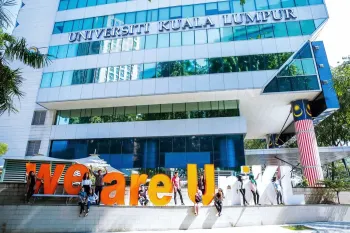
It is housed in a modern glass high-rise building and includes academic, practical, and student support facilities.
Other UniKL campuses are designed around their respective technical industries.
Depending on the institute, students may have access to laboratories, professional workshops, and industrial facilities.
UniKL provides modern classrooms equipped with interactive display systems.
Large lecture halls are also available for courses with higher student capacity while maintaining an organized learning environment.
UniKL operates approximately 300 training laboratories across its academic institutes.
Facilities include:
The university supports applied research through approximately 15 advanced research centers.
Examples include:
UniKL’s library system provides students with:
Studying at UniKL is not limited to classroom education and professional training.
The university also provides students with opportunities for international exposure, extracurricular participation, and personal development.
UniKL offers opportunities to spend a semester abroad through programs and networks such as:
Possible destinations include universities in:
Students can complete approved courses abroad and transfer the credits to their UniKL program.
UniKL maintains relationships with thousands of industrial companies.
The university also operates the INTRA program, a compulsory professional internship that places students in companies for several months before graduation.
In some cases, internships may lead directly to employment opportunities.
UniKL has approximately 60 student clubs and societies.
Examples include:
These activities give students opportunities to develop personal interests, social networks, teamwork, and leadership skills alongside their academic studies.
UniKL also provides services supporting students’ physical, psychological, and professional well-being, including:
Student accommodation differs between UniKL campuses.
Students at the main Kuala Lumpur campus may stay in university accommodation located outside the campus.
Some other institutes, including the Malaysian Institute of Aviation Technology and Malaysian France Institute, provide accommodation within or close to their respective campus areas.
Student housing is separated into male and female residential areas.
Room arrangements may include:
Rooms generally include:
Some selected units also provide air conditioning.
Most residential facilities provide:
UniKL student accommodation is described as one of the more affordable options in Kuala Lumpur because of institutional support.
Monthly accommodation fees range from approximately $27 for basic room options to $150 for higher-level apartment options.
Students should confirm the accommodation available at the specific institute where their chosen program is taught, as housing arrangements differ between campuses.
Admission to UniKL is designed to be relatively accessible for international applicants.
Requirements vary according to the academic level and selected program.
Applicants generally need:
Students preparing for university immediately after secondary school can also review the general guide to studying abroad after high school.
Applicants must hold a Bachelor’s Degree in a relevant field with a minimum cumulative GPA of 2.50 out of 4.00.
Some programs may require a GPA of 2.75.
Applicants with lower academic results may be asked to provide at least 5 years of relevant professional experience.
Applicants must hold a recognized Master’s Degree in a relevant field.
Research-based programs also require a strong Research Proposal.
International applicants generally need:
International students can apply to UniKL online.
The process continues from the initial electronic application through visa procedures and final registration on campus.
Students complete the university’s official application form with their personal and academic information.
Clear digital copies of all required documents must then be uploaded in the requested format.
If the applicant meets the university requirements, UniKL issues an unconditional admission letter.
The student signs and returns the offer before paying the initial registration and student visa processing fees directly to the university.
UniKL submits the student’s visa application through Education Malaysia Global Services (EMGS).
The application is processed to obtain the Electronic Visa Approval Letter (eVAL).
A preliminary medical declaration is required during this stage.
Visa approval generally takes approximately 3 to 6 weeks.
After the eVAL is issued, students visit the Malaysian embassy or consulate in their country of residence to obtain the required entry visa for study.
After the visa is placed in the passport, the student can book the flight and inform the university of the arrival date and travel details.
After arriving in Malaysia, international students present the required immigration documents at the airport.
Within the first 7 days, they must complete a medical examination at an EMGS-approved clinic.
This examination is mandatory for completing the student residence process.
The student visits the registration office at the campus or institute where the selected program is taught.
Original academic and personal documents are submitted for verification.
After the documents are approved and first-semester tuition fees are paid, the university issues the student ID card and confirms the academic schedule.
Malaysia Kuala Lumpur University is particularly suited to students who want to gain practical industry experience before graduation rather than relying only on theoretical academic education.
Its technical institutes, professional training facilities, compulsory industry placements, and internationally connected programs make UniKL particularly relevant to students interested in engineering, aviation, technology, computing, industrial fields, and applied sciences.
Students comparing Malaysia with another popular international study destination can also review the detailed Turkey vs Malaysia study comparison.
If you have questions about UniKL or studying in Malaysia, New Horizons can help you review your academic qualifications, identify suitable programs, and understand the application and admission process.

After many years of working on registering thousands of students in Turkish universities, and answering an unlimited number of questions about studying in Turkey, these are the most important questions that concern students
The official name of the institution is the University of Kuala Lumpur, known locally and internationally by the abbreviation (UniKL).
UniKL is classified as a private university, but it is wholly owned by the Malaysian government through the Malaysian Association of Royal Institutions for Government-Affiliated Universities (MARA), placing it in the category of government-affiliated universities.
The university has direct academic and operational independence as an educational entity, while its strategic and financial oversight remains under the control of the Malaysian government.
Yes, it is one of the best technological universities in Malaysia, and it is distinguished by its practical approach that integrates academic education with direct industrial training.
Direct admission to undergraduate programs requires a high school diploma with a minimum grade of 60% and passing English language requirements such as IELTS or TOEFL.